

Will AI Replace Web Designers?
Learn more

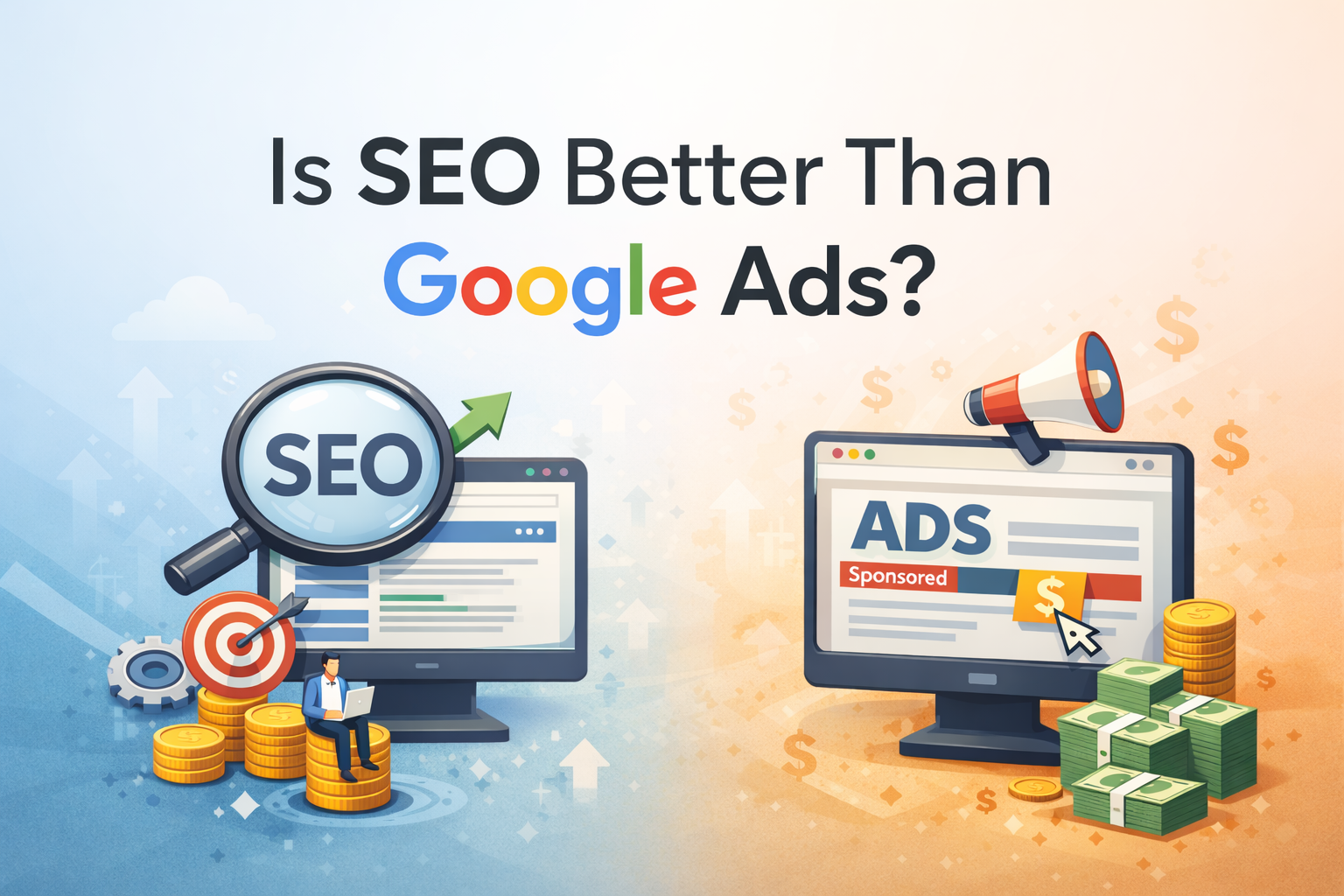
Businesses investing in digital marketing often face the same question: is SEO better than Google Ads? Both strategies are proven ways to drive traffic, leads, and revenue, yet they operate very differently and deliver results on different timelines.
Search engine optimisation (SEO) focuses on improving long-term organic visibility, while Google Ads delivers immediate exposure through paid placements. Understanding how these channels compare and when each is most effective is essential for businesses operating in competitive markets across Queensland and Australia.
This article compares SEO and Google Ads based on performance, cost, sustainability, and strategic fit, drawing from the referenced sources and current best practice.
SEO is the practice of optimising a website so it ranks higher in organic search engine results. Rather than paying for visibility, businesses earn traffic by demonstrating relevance and authority to search engines through content quality, technical performance, and trust signals.
SEO typically involves multiple interconnected components, including keyword research, on-page optimisation, site architecture, content development, and backlink acquisition. These elements work together to help search engines understand what a website offers and why it deserves to rank for specific search queries.
A key strength of SEO is its cumulative nature. While results take time to achieve, strong rankings can deliver consistent traffic for months or years without paying for each click. For businesses with long sales cycles or educational buying journeys, SEO plays a crucial role in building credibility and trust before a customer ever makes contact.
Importantly, SEO must comply with search engine guidelines and Australian Consumer Law. Content must be accurate, non-deceptive, and aligned with the services actually offered—particularly for regulated or professional industries.
Google Ads is a pay-per-click (PPC) advertising platform that allows businesses to appear instantly at the top of search results for selected keywords. Advertisers bid on search terms, and ads are shown based on relevance, bid amount, and quality score.
Google Ads is particularly effective for capturing high-intent users who are ready to take action, such as booking a service or requesting a quote. Campaigns can be tightly controlled by location, budget, device, and timing, making it a powerful tool for short-term lead generation.
However, visibility stops as soon as ad spend stops. This makes Google Ads highly effective—but inherently temporary.
One of the biggest differences between SEO and Google Ads is how costs are structured and how return on investment is realised.
SEO requires an upfront investment in strategy, content, and optimisation. Results usually take months, not weeks. However, once rankings are achieved, the cost per lead often decreases significantly over time, delivering strong long-term ROI.
Google Ads provides immediate traffic but operates on a continuous cost model. Each click incurs a fee, and competitive industries can see high cost-per-click rates. While ROI can be strong, particularly for high-value services, costs scale directly with demand.
From a financial perspective, SEO is generally more cost-effective over the long term, while Google Ads excels in short-term performance and predictability.
Speed is where Google Ads clearly outperforms SEO. Campaigns can be launched quickly, tested rapidly, and adjusted in real time. This makes Google Ads ideal for new businesses, promotions, or time-sensitive offers.
SEO, on the other hand, is slower but far more sustainable. Organic rankings build credibility and trust with users, often resulting in higher engagement and stronger brand authority. SEO also provides resilience against rising ad costs and increasing competition.
Rather than viewing this as a competition, many successful businesses treat speed and sustainability as complementary strengths.
Both SEO and Google Ads must comply with Australian Consumer Law, including rules around misleading or deceptive conduct. This applies to claims, pricing, testimonials, and service descriptions.
In Queensland, businesses must ensure:
SEO content and paid ads should align with these standards to reduce legal and reputational risk.
The answer depends on business goals, timeframes, and budget.
SEO is better for businesses focused on long-term growth, authority, and cost efficiency. Google Ads is better for businesses that need immediate leads, predictable volume, or rapid market entry.
In practice, the most effective strategy is rarely one or the other. Combining SEO and Google Ads allows businesses to capture immediate demand while building a sustainable organic presence.
SEO is not inherently better than Google Ads and Google Ads is not a replacement for SEO. Each serves a distinct purpose within a well-structured digital marketing strategy.
For businesses looking to grow sustainably, reduce reliance on paid traffic, and build long-term authority, SEO is essential. For those needing fast results, competitive positioning, or controlled lead volume, Google Ads remains invaluable.
The most effective approach is a balanced one: leveraging Google Ads for immediacy while investing in SEO for lasting performance and compliance-driven growth.





.png)